
Tapinauchenius
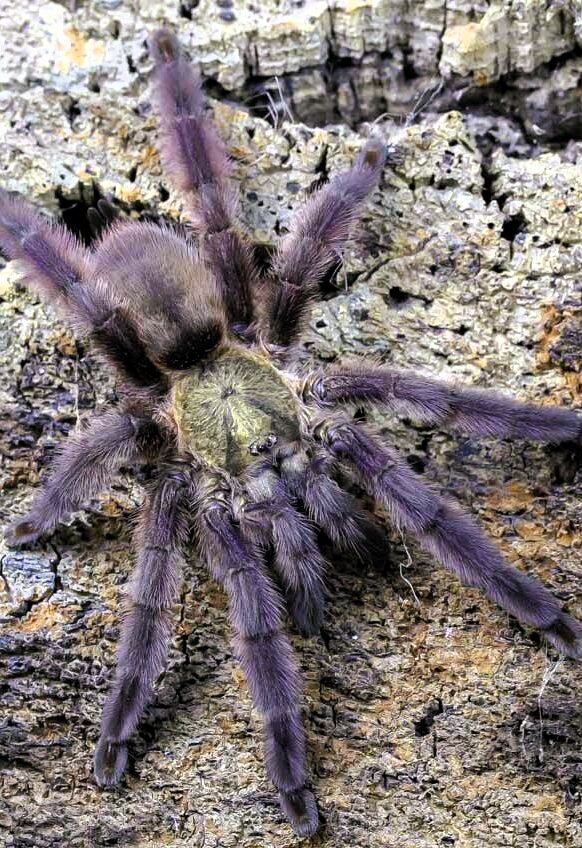
Found throughout northern South America (Brazil, Ecuador, Venezuela, Guyana, Suriname, French Guiana) and the Caribbean, including Trinidad and Tobago, St. Lucia, and St. Vincent and the Grenadines. This species are extremely fast, skittish, and defensive, relying on rapid movement rather than irritation hairs or stridulation. They are relatively small, averaging 4–4.5 inches (100–110 mm) in length
- Tapinauchenius brunneus – Brazil
- Tapinauchenius cupreus – Ecuador
- Tapinauchenius gretae – Brazil
- Tapinauchenius herrerai – Panama
- Tapinauchenius latipes – Venezuela
- Tapinauchenius plumipes– ( Purple Tree Spider ) – French Guiana, Brazil
- Tapinauchenius polybotes – Lesser Antilles (St. Lucia)
- Tapinauchenius rasti (Caribbean Diamond) – St. Vincent and the Grenadines)
- Tapinauchenius sanctivincenti – St. Vincent
The Ultimate Tapinauchenius Care Sheet & Supply Guide
Introduction & Temperament Profile
The genus Tapinauchenius comprises small-to-medium, purely arboreal New World tarantulas native to the tropical rainforest canopies of South America (primarily the Amazon basin and the Guianas). Closely related to the Psalmopoeus genus, they are affectionately known as “Taps” and are celebrated for their sleek, velvet-like bodies and metallic iridescence.
- Behavioral Reality: Do not let their New World classification fool you—Tapinauchenius species completely lack urticating (itchy) hairs. Because they cannot flick hairs for defense, they rely on teleportation-like, lightning-fast speed. They are arguably some of the fastest tarantulas in the entire hobby. While they generally prefer to bolt and hide rather than fight, they can be defensive if cornered.
- Venom Note: Their venom is mild compared to Old World species, but a bite will still cause mechanical pain.
- Experience Requirement: They are strictly suitable for intermediate keepers. They serve as an excellent “bridge” genus for keepers who want to practice managing extreme speed before stepping up to Old World tarantulas like Poecilotheria. Never attempt to handle a Tapinauchenius species.
1. Hardware Shopping List (Everything You Need)
| Component | Target Requirement | Purpose / Notes |
|---|---|---|
| Sling Enclosure | Tall plastic vial or acrylic container (approx. 5x5x10 cm) | Essential for tracking these tiny, hyper-fast spiderlings. |
| Juvenile Enclosure | Vertical acrylic or glass terrarium (approx. 15x15x25 cm) | Provides adequate height as they shift to heavy webbing. |
| Adult Enclosure | Front-opening vertical terrarium (minimum 20x20x30 cm) | Because they stay relatively compact (8 to 12 cm leg span), a massive tank isn’t required. |
| Hardscape | Vertical cork bark slabs or hollow cork rounds | The structural foundation for their intensive tube webbing. |
| Substrate | Coco coir, peat moss, or organic topsoil mix | Retains moisture to help stabilize ambient enclosure humidity. |
| Foliage | Heavy silk or plastic fake terrarium plants | Provides crucial anchor points for their intricate silk tunnels. |
| Watering | Elevated shallow water dish (attached to cork bark or glass) | Essential for tree-dwelling species that rarely descend to the floor. |
| Tools | 25 to 30 cm stainless steel feeding tongs & soft paintbrushes | Vital for keeping your hands a safe distance away from a bolting spider. |
| Safety Gear | Large clear catch cups and rigid plastic/cardboard sheets | Crucial for rehousings to contain their explosive bursts of speed. |
2. Enclosure Design & Webbing Habits
- The “Tube-Web” Architects: Much like Psalmopoeus, Tapinauchenius species are prolific webbers. They will construct elaborate, thick silk tube tunnels that run vertically along their cork bark, often incorporating substrate into the silk to create “dirt curtains.”
- Front-Opening is Mandatory: Because they web heavily near the top and structure their tunnels vertically, using a top-opening enclosure will rip their home apart every time you open it. A front-opening enclosure is highly recommended.
- Cross-Ventilation: Good airflow is highly important to prevent stagnant air and mold, especially since they weave dense webs that can trap moisture. Ensure the enclosure has matching ventilation holes drilled on opposite sides.
3. Climate & Environmental Parameters
- Temperature: Keep ambient room temperatures between 22°C and 27°C. They thrive in warm, stable household conditions.
- Heating Warning: Never use overhead heat lamps or ceramic emitters. If your room drops below 18°C consistently, attach a low-wattage heat mat to the outside upper-side wall of the tank, regulated by a digital thermostat.
- Humidity (70%–80%): As Amazonian canopy dwellers, they prefer higher humidity than desert species. Keep the lower layers of the substrate damp (not muddy), while keeping the top layers relatively dry. Lightly mist the fake foliage or enclosure walls once a week so they can drink droplets.
4. Feeding & Dietary Schedule
Taps have a phenomenal feeding response and grow at an incredibly rapid pace, reaching maturity in as little as 12 to 18 months.
- Approved Prey: Crickets, Dubia roaches, and Red Runner roaches. Ensure the insect is appropriately sized (smaller than the tarantula’s body length).
- Sling Schedule: 1 small insect every 4 to 7 days.
- Juvenile Schedule: 1 to 2 medium insects every week.
- Adult Schedule: 2 to 3 medium-to-large crickets or 1 roach every 10 to 14 days.
- Molting Protocol: When preparing to molt, they will entirely seal the entrances to their silk tube tunnels. Do not disturb them and remove any roaming prey immediately. Leave them completely alone until they emerge on their own with their new exoskeleton.
5. Top Genus Species to Know
- The Plum Tree Tarantula (Tapinauchenius plumipes): The most common species in the hobby. They display a beautiful, velvety olive-brown color with subtle metallic highlights.
- The Violet Tree Tarantula (Tapinauchenius violaceus): Highly sought after for its stunning, deep metallic purple and violet iridescence that shines brightly after a molt.
- The Caribbean Diamond (Tapinauchenius sanctivincenti): A gorgeous species displaying striking metallic green and bronze hues on its carapace and legs.